AI-first observability. Your agent does the debugging.
Your agent sets up TracePath, queries production telemetry, and finds the root cause.
Works with Claude Code, Cursor, Codex, and any agent that reads SKILL.md.
See it in action
Watch an agent set up TracePath, pull production telemetry through the CLI, and walk a bug all the way to its root cause.
From bug report to root cause
Paste the bug report as written. The agent pulls the matching exceptions, the logs around the failure, and endpoint stats, then opens the failing code.
- Grouped exceptions with full stack traces
- Logs correlated by trace id
- First-seen times point at the breaking deploy
- Ends with a proposed fix in your code

A command line designed for agents first
Built for non-interactive use: JSON output, stable errors, and nothing that hangs waiting for input. Humans on a TTY still get tables.
- JSON when piped, tables on a TTY
- --fields trims responses to what was asked
- Stable error identifiers and exit codes
- Mutations require --yes, nothing hangs
Set up by the agent, not by the docs
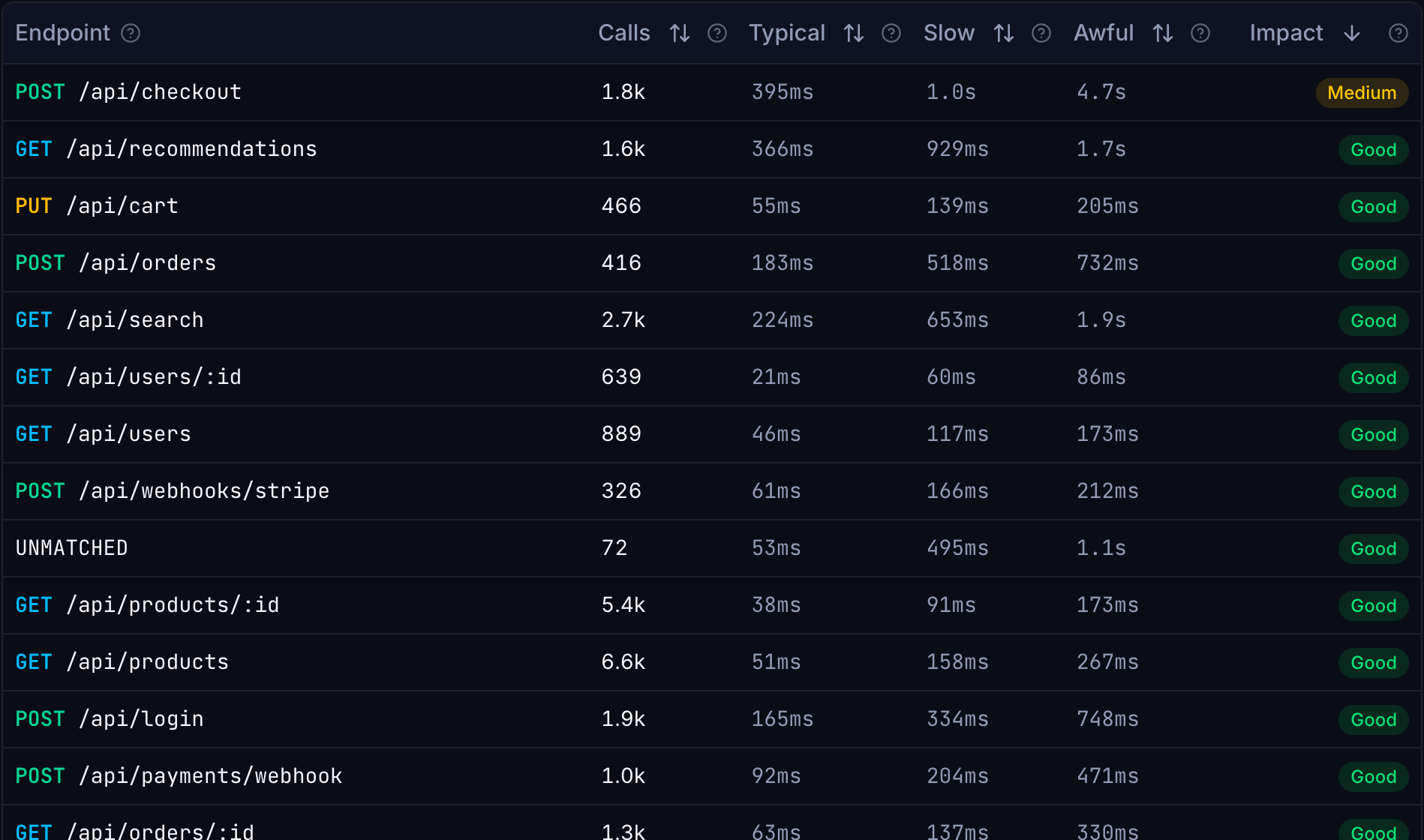
/tracepath-setup picks the right path for each part of the stack: OTel for backends, TracePath SDKs for browser and mobile. Then it verifies data is actually arriving.
- Detects frameworks and services from the repo
- OTel for backends, SDKs for web and mobile
- Covers background tasks, AI traces, and source maps
- Verifies grouped endpoints in the dashboard
Two skills, one install.
Plain Markdown playbooks your agent loads on demand. One sets up your project, the other queries and debugs it.
01 · Setup
/tracepath-setup
Reads your repo and wires it up: OpenTelemetry for the backend, TracePath SDKs for web and mobile. Verifies data arrives clean and grouped.
OTel backendsWeb + mobile SDKsSource mapsVerification02 · Debug
/tracepath
Installs the tracepath CLI, then uses it: exceptions, logs, endpoints, and metrics, from bug report to root cause.
CLI installTelemetry queriesDebuggingIssue triage
One format, every agent
Skills are plain Markdown in the open SKILL.md format. No marketplace, no lock-in. They live in the same MIT-licensed repo as TracePath itself.
Prefer live tools? TracePath speaks MCP.
Connect Claude Code, Cursor, or any MCP client straight to your instance over OAuth. The same telemetry, exposed as MCP tools, prompts, and resources.
Give your agent production context.
Install the skills and let your agent take the next bug.
Questions about agent skills
What exactly is an agent skill?
A SKILL.md file: Markdown instructions your agent loads when a task matches. TracePath ships two, one that sets up a project and one that queries and debugs it. Both live in the open-source repo.
Which agents are supported?
Anything that reads SKILL.md: Claude Code, Cursor, Codex, OpenCode, Gemini CLI, Copilot, and more.
npx skills add tracepathhq/tracepath installs the skills for every agent it finds on your machine.
Can an agent damage my production data?
No. The CLI is read-only apart from archiving exception groups, and that requires an explicit --yes flag.
Does this work with self-hosted TracePath?
Yes. tracepath login --url works against any instance, and profiles let one machine use several.
Do I need the CLI installed first?
No. The /tracepath skill installs and authenticates it before running its first query.
Is there an MCP server too?
Yes. TracePath also ships a Model Context Protocol server: remote over OAuth at https://your-instance/mcp, or local on stdio via tracepath mcp. Skills drive the CLI; MCP gives the agent live tools.