How to build an AI SRE agent [Part 1]
A beginner-friendly walkthrough for building your first AI SRE agent. In this tutorial we'll catch a production error, open an issue, and set up an automatic workflow that runs Claude Code to investigate and fix the root cause. When it's done it will open a PR linked to the original bug, or leave a comment explaining why the issue could not be automatically addressed.
Before we get into it, the usual disclosure: I'm the person building TracePath. Everything below is open source and in the TracePath repo.
Intro
We'll define an AI agent as a tool that uses an LLM to reason, plan and accomplish tasks by calling available tools. Our AI SRE agent will be an automated task triggered when an issue is detected. It will use our telemetry data to reason about the issue and attempt to fix it. The final result will be an explanation of why this cannot be automatically addressed without user input OR it will be an actual code fix. The tools we will use for this are GitHub Issues and Actions as well as TracePath (but you can use any other telemetry platform that gives you observability data access).
Now that we have an idea of what we're building there are a few questions we need to answer:
- How will we trigger the AI SRE agent?
- How will the AI SRE agent access our telemetry data?
- How will the AI SRE agent notify us when the task is completed?
The Trigger
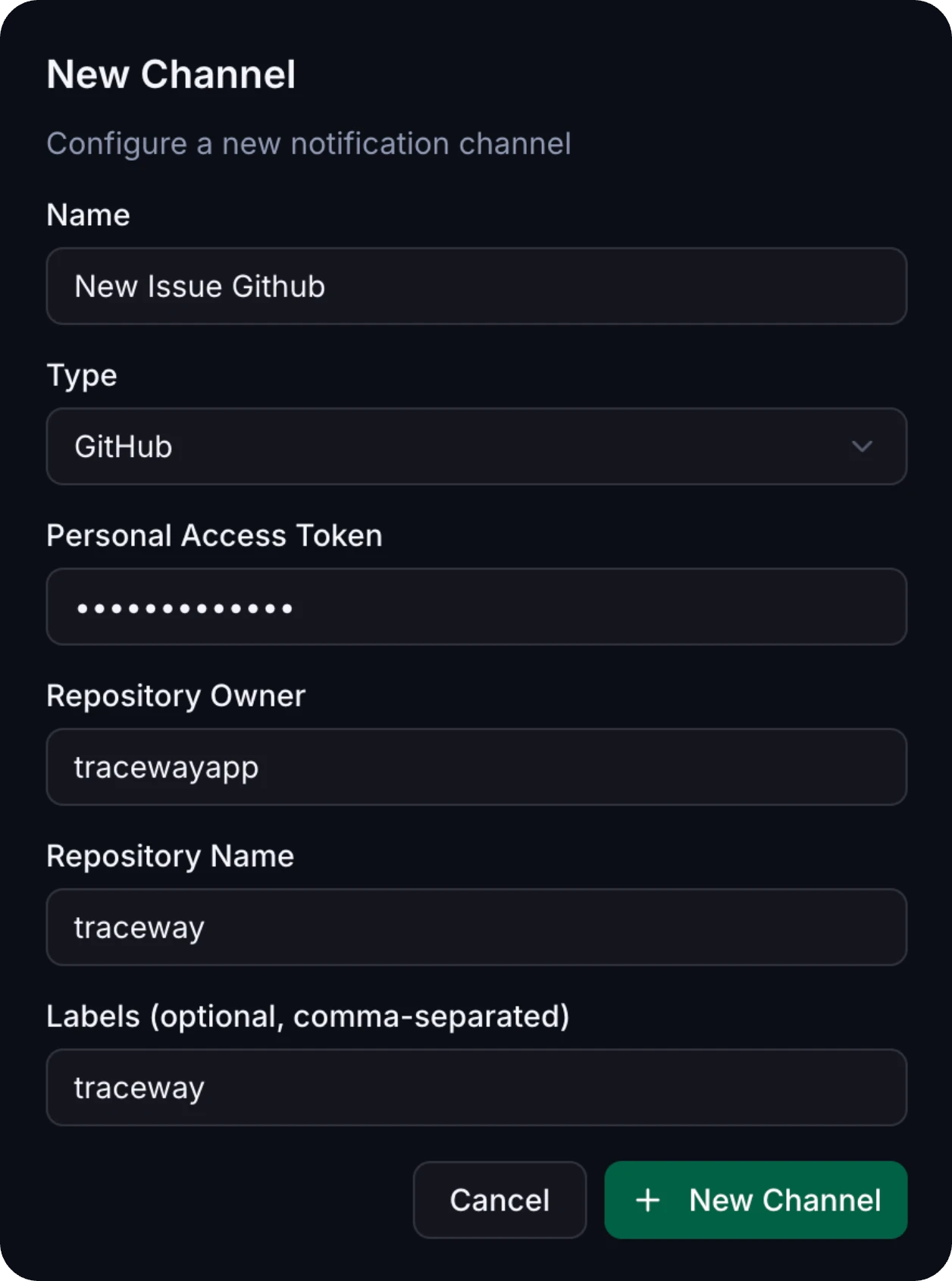
In this tutorial the trigger will be opening a GitHub issue with the 'tracepath' label. This is trivial to set up within TracePath by using TracePath's GitHub notification channel. Here is how to configure it:
In the dashboard, go to Alerts → Channels and add a GitHub channel. It takes a fine-grained GitHub personal access token with issue write permission on your repo, the owner and repo name, and a list of labels. Put tracepath in the labels field. This matters more than it seems: the channel applies exactly the labels you configure, nothing is automatic, and that label is the tripwire the workflow listens for. If the labels field is empty, issues still get created and the workflow never fires, silently. Don't reuse a label humans also apply by hand.
Then add a rule: type New Issue, attached to that channel. This is what actually gets TracePath to notify your channel when a New Issue shows up.
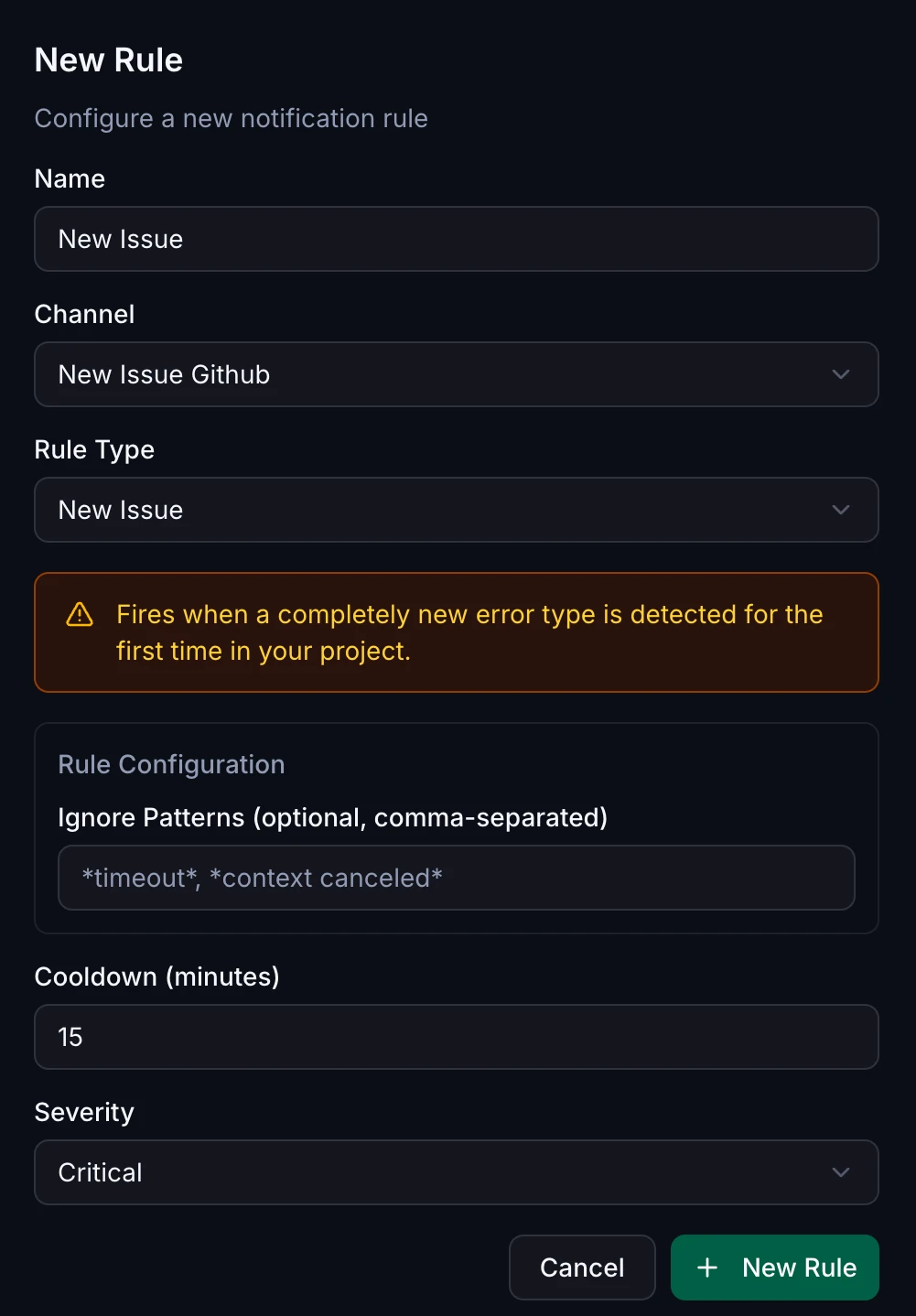
With this setup, every new exception will automatically create a GitHub issue on our behalf.
Our agent will execute as a GitHub Action. To set up our trigger we will do:
name: TracePath auto-fix

on:
  issues:
    types: [labeled]

jobs:
  fix:
    if: github.event.label.name == 'tracepath' && github.event.issue.user.login == 'dusanstanojeviccs'
    runs-on: ubuntu-latest
    timeout-minutes: 30
    concurrency:
      group: tracepath-fix-${{ github.event.issue.number }}
    permissions:
      contents: write
      pull-requests: write
      issues: write
      id-token: write
    steps:

... more to come, keep reading
The key line to pay attention to is the 'if:' on line 9. We are limiting the trigger to be a new issue with the label 'tracepath' AND we are limiting it to be our specific user, in this case me. The reason for this is that the TracePath repo is public. Without locking the trigger to a specific author, anybody could create an issue with the tracepath label, trigger the task and burn precious tokens, or worse, attempt to inject malicious prompts (more on this later).
Telemetry Access
From now on, the first occurrence of any new exception hash creates an issue that looks like this:
[tracepath-cloud] New error: *fmt.wrapError

A new error has been detected: *fmt.wrapError

Exception ID: f05d86a5-9135-4cd6-b11d-b9338fed98ee
Hash: 2e16546cedb34a03
Occurred at: 2026-07-28 05:13:40 UTC
Server: ip-172-31-39-42

Stack trace:
*fmt.wrapError: OAuth complete failed (provider=github): could not find
a matching session for this request
oauthController.Callback()
    .../backend/app/controllers/oauth.controller.go:79
  ...

View details: /issues/2e16546cedb34a03
That's a real one from our production, and those three lines in the middle matter. Hash identifies the exception group, Exception ID plus Occurred at identifies the exact occurrence. The key is to make sure your notification carries enough information for the AI agent to know how to access it. For example, in the case of SLIs you will want to be very specific as to which SLI was broken, how and when.
We don't have to worry about those things with TracePath as it already provides this info by default and the TracePath skill we will let the agent use knows how to parse all of them out of a notification body.
To let the agent access this data TracePath exposes two paths:
- CLI + Skill
- MCP
For the sake of keeping this tutorial light we'll use the CLI + Skill setup. The CLI will expose a read-only view of the telemetry data stored in TracePath and the skill will explain to our LLM how to use it to look for the root cause of the issue.
To set this up with our previous GitHub action we will add CLI install and login as steps:
- name: Install the TracePath CLI
  run: curl -fsSL https://cli.tracepath.dev/install.sh | sh

- name: Log in to TracePath
  run: |
    printf '%s' "${{ secrets.TRACEPATH_TOKEN }}" | \
      tracepath login --url "https://cloud.tracepath.dev" --token-stdin
    tracepath projects use "${{ vars.TRACEPATH_PROJECT_ID }}"
Running the LLM (Finally)
Now that we have a trigger and we have access to the telemetry data it's time to start Claude (yayy!!1).
To do this we will add another step to our GitHub workflow:
- name: Investigate and fix
  uses: anthropics/claude-code-action@v1
  with:
    anthropic_api_key: ${{ secrets.ANTHROPIC_API_KEY }}
    plugin_marketplaces: |
      https://github.com/tracepathhq/tracepath.git
    plugins: |
      tw@tracepath
    claude_args: |
      --model claude-opus-4-8
      --effort xhigh
      --allowedTools "Bash(tracepath:*),Bash(jq:*),Bash(go:*),Read,Edit,Write,Glob,Grep"
      --max-turns 60
    prompt: |
... don't be too hasty we'll get to the prompt ...
This step is awesome, it triggers Claude Code with the Opus 4.8 model and the effort set to xhigh. The key part here is the tool allowlist: we're only giving the LLM the handful of tools it needs to investigate and edit code. We are NOT giving it access to mess with GitHub. We want to limit the exposure and the possible injection vector. We don't fully control what exceptions get thrown, what spans/attributes get created in our system and we don't want to give the LLM any permissions that might be destructive. It will do its work in the repo, post its results in the Action and then the next step will deterministically decide what to do with those results.
Also note the max-turns 60 cap: if the agent hasn't finished by then the run is cut off, so a stuck loop can't burn tokens indefinitely.
The Prompt (do not make mistakes)
The prompt is honestly pretty basic, it tells the LLM what to do. The LLM will use your repo's CLAUDE.md file but as I've come to learn the hard way it can ignore it. The CLAUDE.md file is more like a suggestion, the prompt is much more likely to be followed. Here is what our prompt looks like:
TracePath detected a production error and opened issue
#${{ github.event.issue.number }} in this repository. The full
notification is between the markers below.

--- TRACEPATH NOTIFICATION ---
${{ github.event.issue.title }}

${{ github.event.issue.body }}
--- END NOTIFICATION ---

Investigate this with the tracepath skill from the tw plugin:
invoke the skill and follow its Debug flow, treating the
notification above as the issue reference. The skill knows how to
extract the Hash, Exception ID, and Occurred-at timestamp from a
TracePath notification, resolve the "View details" URL, and drill
from the occurrence into traces, sessions, and logs. The tracepath
CLI is already installed and authenticated against the correct
project; never run `tracepath login`.

You have NO access to git or gh, and you must not attempt to
commit, push, or call any network tool. A later workflow step
handles all of that. Your job is only to investigate, edit files
in the working tree if a fix is warranted, and write a report.

If the investigation ties the root cause to code in this
repository, fix the cause, not the symptom. Keep the diff
minimal. Run the relevant Go tests for the packages you touch.
If you cannot tie the root cause to code with confidence, do NOT
guess a fix; leave the working tree untouched.

Do not add code comments explaining your change, why it is
correct, or what the error was. The diff must read like the
surrounding code, following the repository's CLAUDE.md style
rules. ALL explanation belongs in the report file, none of it in
the code.

When you are done, write your report to the file
"$RUNNER_TEMP/fix-report.md" in exactly this format:

Line 1: "STATUS: fixed" if you applied a fix, "STATUS: analysis"
if you investigated but did not change code, or "STATUS: no-hash"
if the notification contained no Hash (for example a channel test
notification).
Line 2: "HASH: <the exception hash>" or "HASH: none".
Line 3 onward: your root cause analysis in markdown. If STATUS is
fixed, explain the root cause, the fix, and how you verified it,
and include the "View details" link from the notification. This
text becomes the pull request description or the issue comment,
so write it for a human reviewer.

The report file is mandatory. Write it even when you change
nothing.

Never create helper scripts, notes, or any other scratch files
inside the repository working tree; everything that ships in the
working tree becomes part of the pull request. Use $RUNNER_TEMP
for anything temporary.
Handling the result (PR or comment)
Now we have a few more steps to go. We need to decide if the agent was able to fix the issue or not. If the fix was straightforward we'll open a PR. If not, we'll leave a comment on the GitHub issue.
Here are the steps we'll use for that:
- name: Save diff and report as artifact
  if: always()
  run: |
    mkdir -p "$RUNNER_TEMP/artifact"
    cp "$RUNNER_TEMP/fix-report.md" "$RUNNER_TEMP/artifact/" 2>/dev/null || true
    git add -A
    git diff HEAD > "$RUNNER_TEMP/artifact/fix.patch" || true
    git status --porcelain > "$RUNNER_TEMP/artifact/changed-files.txt" || true

- uses: actions/upload-artifact@v4
  if: always()
  with:
    name: tracepath-fix-issue-${{ github.event.issue.number }}
    path: ${{ runner.temp }}/artifact
    if-no-files-found: ignore

- name: Publish result
  env:
    GH_TOKEN: ${{ secrets.GH_PUSH_TOKEN }}
    ISSUE: ${{ github.event.issue.number }}
  run: |
    REPORT="$RUNNER_TEMP/fix-report.md"
    if [ ! -f "$REPORT" ]; then
      gh issue comment "$ISSUE" --body "The auto-fix agent finished without producing a report. Check the workflow run log."
      exit 1
    fi

    STATUS=$(sed -n '1s/^STATUS: *//p' "$REPORT")
    HASH=$(sed -n '2s/^HASH: *//p' "$REPORT")
    BODY=$(tail -n +3 "$REPORT")

    if [ "$STATUS" = "fixed" ] && ! echo "$HASH" | grep -Eq '^[0-9a-f]{16}$'; then
      gh issue comment "$ISSUE" --body "The agent reported a fix but an invalid hash ('$HASH'); not opening a PR. Check the run log."
      exit 1
    fi

    if [ "$STATUS" = "fixed" ] && [ -n "$(git status --porcelain)" ]; then
      git config user.name "github-actions[bot]"
      git config user.email "41898282+github-actions[bot]@users.noreply.github.com"
      gh auth setup-git
      BRANCH="tracepath/fix-$HASH"
      git checkout -b "$BRANCH"
      git add -A
      git commit -m "Fix production error $HASH"
      git push -u origin "$BRANCH"
      { echo "Fixes #$ISSUE"; echo; echo "$BODY"; } | \
        gh pr create --title "Auto-fix: tracepath $HASH (issue #$ISSUE)" --head "$BRANCH" --body-file -
      tracepath exceptions archive "$HASH" --yes
    else
      { echo "Auto-fix agent report (no PR opened):"; echo; echo "$BODY"; } | \
        gh issue comment "$ISSUE" --body-file -
    fi
The Results
I've run this a few times.
The first time the result was a PR, which you can find here. I really liked the approach: it stopped escalating an error that can be triggered by bots or by users simply waiting too long to authenticate. What I really disliked was the code that was written, pointless comments and a function that could literally just be a direct if statement. It's the solution I would go for but not the code I would have written.
So I tried again, this time the result was not a PR but a GitHub issue comment. The agent decided that it understood the issue but was unsure whether lowering the reporting level was the right fix.
I found this to be really interesting, two runs of the exact same problem but completely different results.
The full workflow is located here. The issue used for testing is here and the PR one of the runs opened is here. To set up the same workflow you will need these configured in your repository settings:
| Name | Kind | What it is | Where to get it |
|---|---|---|---|
ANTHROPIC_API_KEY | Secret | The API key Claude Code uses, this is the one that costs money so set a spend limit on it | Anthropic Console under API keys |
TRACEPATH_TOKEN | Secret | A personal access token (otp_...) the CLI uses to read your telemetry, shown only once so copy it right away | TracePath dashboard, Account → Personal access tokens |
TRACEPATH_PROJECT_ID | Variable | The ID of the project your app reports into, it's just an address so it doesn't need to be a secret | The projectId query param in your TracePath dashboard URL |
Reflection
This is by no means a production level AI SRE agent that you should implement today, but it is the start of one.
While building it I had to start thinking about whole new sets of issues, primarily around security. It was crucial to limit who can trigger the agent, restrict the LLM to commands that can't do damage, and move everything dangerous into deterministic workflow steps.
Another thing that I did not expect was that the agent made two completely different decisions in two separate runs and decided to ignore the CLAUDE.md instructions on how to write code leading to pretty mediocre results. Focusing on driving outcomes will be next, evaluating the changes done to the prompt/tooling/steps/skills will probably play a much larger role than the changes themselves. Having a non deterministic system and trying to improve upon it will obviously require a lot of measurements.
The final thing that this little experiment left me thinking about is the observability piece of the agent itself. I spent a total of ~$10 across 3-4 runs of the agent, it was easy to track and to check what the agent was doing. Running this at scale would be a completely different beast. The GenAI spec in OTel is done and having great support for it in TracePath is on my roadmap, building a better agent will help me make sure it's implemented well.
I'm building this in the open. TracePath is MIT-licensed and OpenTelemetry-native, and everything described here ships with it. If you wire this loop up and an agent fixes a real bug while you were asleep, I genuinely want to hear about it: [email protected].